
Systems that work on the day someone needs them
What we cover on a campus
Boundary walls, vehicle and pedestrian gates, and the after-hours picture. On a campus the perimeter is the first thing designed and the first thing an inspection asks about.
Main entrances, reception and the gate at dismissal — where a school needs a clear record of who collected whom, and a hospital needs to see who came through outside visiting hours.
Corridors, stairwells, halls, waiting areas and canteens. Positioned at the choke points people actually pass through, not spread evenly across a floor plan.
Records rooms, server rooms, pharmacy and lab stores, accounts and admin. Camera coverage paired with an access log answers questions neither answers alone.
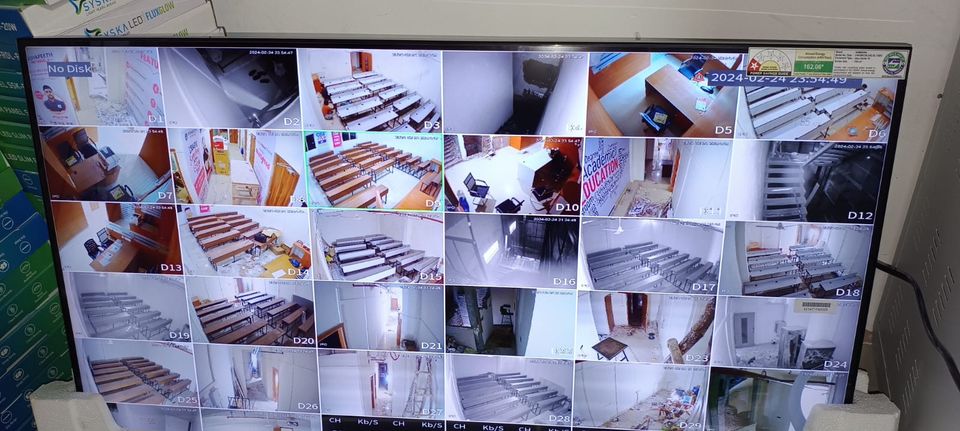
Institutions carry a different kind of accountability. A school answers to parents, a hospital to patients and their families, a government building to the department that funds it — and all three answer to an inspection at some point. That changes what a security system has to do. Coverage matters, but so does whether the system is still working in month eighteen, whether the footage can be found and released properly when it is asked for, and whether the equipment on the network is the kind your procurement rules allow.
Why institutions choose Logikdesk
Reliability first. On most sites a dead camera is an inconvenience discovered late; on a campus it is the one camera someone needed. So the design accounts for it — recording health, storage headroom against your retention period, and a maintenance schedule that checks the system rather than waiting for a complaint.
Then documentation. The design is written down before installation: coverage drawing, bandwidth and storage calculations, BOQ, and the reasoning per location. Administrators are usually presenting this to a management committee, a trust board or a department, not deciding alone — so it is written to be read by someone who was not on the site walk.
Then hardware you can defend. Every model is verified STQC-certified before order, and where procurement rules or a funding condition restrict equipment origin, that constraint shapes the shortlist at design stage.
Cabling across a multi-building campus
A campus is not a larger office. Runs cross between blocks, distances exceed what copper will carry, and the route matters as much as the cable — buried conduit, overhead spans, existing ducts of unknown age. Inter-building links are designed on fibre where the distance calls for it, with copper (Cat6 or Cat6A) inside each block, and the whole thing labelled at both ends and tested with the reports in your handover file.
Where a campus grows one building at a time, the cabling is designed for the campus rather than the building in front of us — spare capacity in the backbone, and a documented scheme so the next block does not mean re-planning the first three.
Compliance for government and semi-government buildings
This is where institutions differ most from a private office, and it is worth being specific.
Government and semi-government buildings frequently sit under procurement rules that restrict where surveillance equipment may originate. The relevant standard most often cited is NDAA Section 889, and its practical difficulty is not avoiding the named manufacturers — it is that a great many familiar brands sell rebadged hardware built by them. The housing changes; the chipset does not. NDAA and supply-chain security covers what to check and why a model number matters more than a brand name. Aided institutions, PSU premises and facilities taking central or state project funding are the ones most likely to be asked, and usually at the point where the equipment is already installed.
Alongside that: STQC and the essential requirements is the Indian certification baseline every camera we specify is checked against, and the DPDP Act and CCTV footage covers retention, access control and disclosure — the part that matters when footage involves students, patients or the public, and someone asks for a copy.
If you have an existing system and none of this is documented for it, our security audit produces a written gap report you can put in front of your management or your auditor.
Maintenance is not an optional add-on here
On a warehouse, a camera down for a fortnight is a gap in a report. On a campus it is the reason a question cannot be answered. Cameras fail quietly — a drive drops out of the recorder, a dome fogs, a connector corrodes, retention silently shortens as storage fills — and none of that announces itself.
An AMC with scheduled preventive maintenance is the part of this we would push hardest for an institution. Scheduled visits against a written checklist, recording and retention verified rather than assumed, firmware kept current, and a report after each visit so your administration has a record that the system was checked and working. It is the difference between owning a system and assuming you have one.
Survey, design, and a phased handover
The survey covers the whole campus, not a representative building — boundary, gates, circulation routes, the blocks and their ages, existing cabling and access control, and the periods when work can and cannot happen. The design comes back in writing for your review before anything is procured.
Installation is phased: block by block or wing by wing, sequenced around teaching hours, ward occupancy or public timings, and against a method statement your administration signs off first. Handover is a file — test reports, STQC certificates, the drafted retention and access policy, and credentials transferred securely to named people — followed by the AMC schedule that keeps it that way.
- STQC-verified
- NDAA-aware shortlist
- Fibre inter-building links
- Scheduled AMC visits
This page describes installation, documentation and maintenance practice. Safeguarding, patient-privacy and records obligations are set by your own regulator, management and policies — a security system is designed to support those, not to substitute for them.
Frequently asked questions
Can the work be done without disrupting classes or wards?
Yes, and on a campus it usually has to be. Installation is phased building by building against a method statement agreed with your administration — vacation windows and low-occupancy periods for schools and colleges, planned wing-by-wing sequencing for hospitals, with hot works and drilling scheduled away from occupied areas.
Who is allowed to view footage once the system is live?
Whoever you decide, and it is configured that way at handover rather than left open. Named roles, individual logins instead of a shared password, and a log of exports. We hand over a drafted retention and access policy for your management to review and adopt.
What happens when a camera fails six months after handover?
That is what the AMC is for. Scheduled preventive visits with a written checklist, health checks on recording and retention, and a report after every visit — so a fault is found on a maintenance round rather than on the day footage is asked for.